Thursday, March 8, 2012

Life Returns to the Uroboros/ Space Does Not Go Anywhere/ Parts 25 and 26


By Brian George

25

“I don't develop; I am.”—Pablo Picasso

In “The Republic, Book X,” Plato writes, “When all the souls had chosen their lives, they went before Lachesis. And she sent with each, as the guardian of his life and the fulfiller of his choice, the daimon that he had chosen, and this divinity led the soul first to Clotho, under her hand and her turning of the spindle to ratify the destiny of his lot and choice, and after contact with her, the daimon again led the soul to the spinning of Atropos to make the web of its destiny irreversible, and then without a backward look it passed beneath the throne of Necessity.”

26

As you read (or hear) this, my voice echoes in your short-term and then long-term memory. As I speak to myself I imagine your—as of yet—nonexistent face. We both ask, “Who let You in here?” Daylight savings time assaults the nocturnal light of dreams. It does no good. Earth suddenly goes black. The transparent moon returns. To what end should we argue about the title of the preexistent death-flash video? Dreams hang on the tree of knowledge. It continues to sprout branches. Images are waiting for whoever stops to try them on.

The dead reproduce. Cities land on clouds. An epileptic bird damns robots to the labyrinth. Earth’s rulers act at a distance, as mechanics reverse the pull of the great magnet of dissociation; you are not where you are. Your small hands violate the precession of the equinox. It is clear to me stranger that your tribe grows monstrous. Your prehistoric boats now dare to take x-rays of omphalos!

Of course, it is also clear that you do not approve of me. I copulate with a race of questionable gods. A starfish is my master. The most considerate thing would be for each of us to go back where we came from.

Symbols exchange fluids. You wake smelling of the ocean. Someone has put seaweed in your hair. A squid snores beside you. Is everything ok? A spell enforces the inviolate order of appearances.

What a strange thing it is for the self to be inhabited by the other. How strange to be almost dead, to be viewed by other subjects as an object. What a strange thing it is to forget one's mother tongue. How strange to be an omnipotent mushroom trapped inside an atom. How strange to find yourself projected into someone else's dream—to know it is not yours, but not be able to get out.

There is a unique horror to such experiences. How odd, since they are nothing if not common. How quickly the disorientation is written off as over. Hermes goes in one ear; a pedestrian falls out the other. Amnesia voids the traveling violation. The ego is a useful construct; it allows us to take possession of even the most surreal of events.

Perhaps each of us inhabits and acts out not one but many dreams. Their intersection allows us to create a role for choice. If the role is real, it is also perhaps more circumscribed than we are willing to admit.

In the physical world each actor sees himself as the enormous central character, without whom no story would exist. The actor is provisionally conscious. Let us say that the ego gets with the preexistent program. The actor follows where the death-flash video leads, as the future and the past trade places. You are that actor; the remnant of the shadow of an enigma, the warrior once swallowed by the dream. You will work with the phenomena that present themselves. You will use what is put before you.

Doors open as you pass. Impediments dissolve. Your head cracks like a seed— whose chromosomes go crazy. Junk DNA becomes an audio-book, a spiral memory theatre, a see-through encyclopedia whose symbols you can read. It does not appear that your memory is native to the Earth. Your arms reach for the land of no return—where a radioactive treasure blossoms. Omens bounce. Empires fall up. Your heart is in your mouth. A breeze harvests you.

If you cooperate with the instructions that the three fates have embedded in the dream, it is possible that you may actually have fewer choices. Paradoxically, you may also experience a greater wealth of opportunities. Freedom becomes less of a burden in becoming less rational and more intuitive; action becomes an aspect of attention. Knowledge roars like a recombinant species. An instruction manual on ecstatic death appears, a bit wrinkled from the flood, perhaps, but just lying on one’s doorstep and waiting to be picked up—as if we and not death had all along been the problem!

Water fuels the broadcast of the social hallucination. Boundaries are plastic. Voices interpenetrate. Faces serve as cues to prompt the interest of the dead, who, for the past 12,000 years, have had better things to do.

“Hey, I know him,” one exclaims, “that is Argos Panoptes, of the 360 degree vision, who Hermes—that delinquent—had once hypnotized with his music, then beheaded!” Once, the world was much smaller than it is today—about the same size as an eye—while the beings who inhabited it were almost infinitely large. Sex is happy to interpret the most abstruse of symbols. As you exit the labyrinth, light towers to the sky. You are right at home. The hand of synchronicty throws gifts across your path.

(Illustration: Rene Magritte)

Monday, March 5, 2012

Life Returns to the Uroboros/ Space Does Not Go Anywhere/ Part 24


By Brian George

The objective world presents us with a wealth of information. There are clues to follow, patterns to trace, enigmas to wrestle to the ground, keys to discover, signs in foreign languages to obey, labyrinths of interconnection—through which a string may be rewound into a ball. An acupuncture manikin is waiting at the exit; she is the beloved—who transforms.

“Immortal mortals, and mortal immortals, each living the other’s death and dying the other’s life,” as Heraclitus said. After study, we may more fully understand how the part relates to the whole. What are we? Where do we come from? Where are we going? Is the self the shadow of a nonexistent sun? How does our consciousness interface with the sex-life of the world?

One approach is to regard the human body as a microcosm, in which each detail of anatomy corresponds to some macrocosmic coordinate. It is possible that space is actually no bigger than an ovum, in relation to which each life is a kind of kamikaze spermatozoon. If we say that nature is made up of “laws,” does this not imply that we have chosen to obey them, and that, with a fluctuation in our mood, we might just as easily choose to disobey?

But whatever the method we may choose to follow—esoteric or empirical—we may find ourselves no closer to answering the key questions we have asked. The whole problem may be in the method of our asking. We are too polite, and should not ask teachers for help. We must locate by blind reckoning the beginning of each circle.

In his “Oration on the Dignity of Man”—a kind of shotgun marriage of Kabbalah and Neoplatonism—Pico della Mirandola argues that human beings and not angels are the true messengers of creation. I had originally written, “Human beings and not angels ATE the true messengers of creation.” My wife pointed out the problem. But the accident was perhaps correct. And so, to paraphrase Pico della Mirandolla:

To all other species one nature was assigned; each had a single job to do. Beasts are less contemptible than we are. The damned feel glory over us. It is the very lack of a fixed role that defines our position in the hierarchy. We are many—and one self embodies the diverse powers of the spheres. In being nowhere we are able to be everywhere. In being nothing we are able to create and then interpret our own project as we go.

The Human Consciousness Project predates the disjunction worked by the Deluge. Age by age, in a series of slow, catastrophic steps, we forgot that the sum of knowledge was contained within one volume. We forgot, as well, that the human body was a star map and an atlas. Today, we write things down. Decadence makes meaning necessary.


(Illustration: Rene Magritte, The Philosopher's Lamp)

Thursday, March 1, 2012

Life Returns to the Uroboros/ Space Does Not Go Anywhere/ Parts 22 and 23

By Brian George

22

To the radioactivity of an object out of mind each detail of one’s memory is a screen. Quite suddenly, as though no time had passed, the whole of history weighs no more than a feather. It is once more possible to review one's death on video. Again, the music of the spheres is audible, or even overwhelmingly loud. There are no hypnotic fields to block access to the macrocosm. If a tribe of watchers appears to be sitting on one's head, you can rest assured that this is purely a coincidence.

23

Gaps open. There are conflicts among the forces that govern the microcosm and the macrocosm. Scientists now compete to develop a Unified Field Theory—or a Theory of Everything, as it is sometimes called—that will unify the principles of relativity with those of quantum mechanics. No one knows what the new universe will look like, or who will discover the theory, or what strange games it will play with our consciousness, but many do believe that such a theory will exist in the nest 20 or so years.

It is tempting to think that the Human Consciousness Project could be brought to some similar resolution. The ancestral war between the subject and the object would end not with a bang but with a wedding. The neocortex would be transubstantiated. Dance would spread like a virus through the Luddite version of the World Wide Web. With their planetary chanting, cyborgs would awaken every megalith at Stonehenge. Intellect would lift all symbols from the sewers of the Sargasso Sea.

The New World Order would not depend on oil, but, instead, on breath. Clones from a Calvinist think tank would give away their hearts, their car keys and their houses, as they ran to hug random derelicts on the street. Prosthetic limbs would attach themselves to torsos. Nanotechnocrats would free the great apes that were hung on the tree of recombinant knowledge.

These microcosmic adjustments would be good. It is more likely, however, that philosophy does not progress. Nagel is smart, but not necessarily more evolved than Plato. Parallel universes agree to disagree. An 11-dimensional superstring coordinates the agon. If consciousness grows from the discovery of a preexistent object—the knowledge guarded by the self, to which the other had systematically denied access to the ego—then the resolution would occur not in the future but in the past. A mysterious conjunction has already taken place.


(Illustration: Pierre Roy)

Sunday, February 26, 2012

Life Returns to the Uroboros/ Space Does Not Go Anywhere/ Part 21

By Brian George

Where should the snake locate meaning in the dream of the objective world? We can study the growth of plants, the silent honor code of the chromosome, the formation of crystals. We can plot the movements of the Earth's tectonic plates. We can say that gravity is a field capable of action at a distance, or that an object will move at a continuous velocity—unless it is acted upon by an external force.

There are different laws for different classes. Each class can be regarded as an object. Different lenses create different appearances.

We can say that in a closed system energy is conserved—when heat is taken into account. It is true also that entropy rules. We can note that water burping down a bathtub drain moves in the same spiral motion as the galaxy. Belief tells us that an abstract singularity preceded the Big Bang. Others believe that there was life before the egg, that a hand made the macrocosmos.

It is possible to build a world from correspondences. We can posit that trees are a solidified slow-motion form of lightning. As above, so below—their life force follows the same fractal branching. We can say that, for the most part, evolution creates forms that are more and more complex. Through objective austerities light learns to curve. Time is what is measured by a clock. Einstein's brain is perhaps an improvement over that of a protozoon. There are anomalies, of course. It is certainly odd that Mozart's brain is smaller than that of the Paleolithic shaman.

Meanings point everywhere. The self is an experiential object. A bird opens the intestines of the philosopher with a key. An atomic energy commission charges, having come to monitor the breech birth of free energy. The other world institutes a chain reaction. A philosopher is first and foremost a human being—an unconscious object waiting to be born, a subject caught in the net of interdependent origination. He should not lead with his mind where his body cannot follow.

Forgetfulness brings the body of the world / snake into focus. I know this from my own experience, for, at the age of 18, I saw the world destroyed. To this day, I still hold myself responsible.

My crime was this: I discovered that no object was inanimate. No, for our own safety, we just pretended that they were. Each object was inherently unstable. It could overheat, like the rods in a nuclear reactor, and, if one stared at its light for more than a few seconds, it could easily melt down. Winds would rip away the cardboard of appearances, to leave only an epileptic sea.

Before birth, we had passed beneath the stern gaze of Necessity, which caused us to forget the extent of what we knew. So too, as our energy expands, we must choose to forget that we only have two eyes. If, suddenly, we were able to see from all of 360 degrees, it might be difficult to act out our own part in the story, since we would not be sure whose face was looking back from the mirror. There are worlds inside of worlds.

All of them look real. Each is real, in its way, yet only to the extent that we have limited our focus, and then chosen to agree upon a single set of laws.

Conscious and unconscious methods must collaborate to create a Unified Field Theory.

Some say that the world snake is for use, others that he keeps the philosopher for a pet, and still others that the figure 8 is the most beautiful of conundrums. “A hidden connection is stronger than an apparent one,” as Heraclitus said. The more an object changes the more it becomes more fully what it is. Human consciousness is perhaps the irreducible element. It is the shadow cast by an untranslated symbol, the dream left over, the philosopher's stone hatched from the fires of the althanor.


(Illustration: Rene Magritte, The Liberator))

Thursday, February 23, 2012

Life Returns to the Uroboros/ Space Does Not Go Anywhere/ Section 20

 By Brian George

In “Working Notes,” Merleau-Ponty writes, “Meaning is invisible, but the invisible is not contradictory of the visible: the visible itself has an invisible framework, and the in-visible is the secret counterpart of the visible.”
__

There is a disconnect between the software and the hardware of the human consciousness project. The creative will has withdrawn to a dimension of its own, as have the earliest races. We cannot motivate the inanimate god to dance.

It would be hard to understand a Beethoven symphony by taking apart the radio through which it had been broadcast. The music has no one meaning; they are many. Communication follows on the self's attunement. Love helps also—to a degree.

As detached observers we have inadvertently become members of a cargo cult. Ceremonies of innocence ensue. Dreams explode with promises of apocalyptic contact. Drums imitate the oceanic movement of the symphony, which the seer, at the end of a three-day, torture-induced trance, once heard in a transcription for kazoo.

Like the eye of god, a great propeller turns at the center of the airplane altar. Oil burns in the tin-can lamps that adorn the blackened fuselage.

In the cockpit—or rather the few jagged shards that are left—the eight arms of the pilot are left to decompose where they fell. Row upon row, other canned goods have split open. Flies buzz to celebrate the superabundant wealth.

In awe, and with decontaminated hands, we lay out the components of the radio on the beach. There is no climax. A wave of melancholy washes the high spirits from the cult. Contact with the alien relic brings no illumination.


(Illustration: Alberto Savinio)

Wednesday, February 22, 2012

Life Returns to the Uroboros; Space Does Not Go Anywhere/ Section 19


By Brian George

Where in the objective universe would we look for human meaning? What exactly would it look like? Would we know it if we found it, and if so, how? The Human Consciousness Project finds only correspondences.

Let us think of the objective universe as a stage—where arc lamps throw enormous shadows. The subject, and the things that he writes, are small. Thus, in the beginning, is the word, before glyphs are cast into disconnected sentences. In turn, these serve to coagulate the ocean. Some glyphs are bent and mutilated by the format of thee tornado, which spits them out. Others stick like bones out of the black mud of the flood-plain. Again, Earth’s axis tilts, removing every megaplex that is larger than a seed.

Each actor comes equipped with a mobile alexandrine library, which, to some, looks much like DNA. It is stocked with overdetermined symbols, whose implications it is up to him to intuit, as he learns to see without eyes.

Homer dreams of the discovery of Troy by Hienrich Schlieman. A mere 2600 years later, in his top hat, Schlieman starts to dig. Death comes to Aeschylus in the form of a falling turtle—that an eagle attempts to crack open on his head. There are no books inside. The Dark Ages do not begin in 476 AD. The birth of literacy, says Plato, is the beginning of the end.

With his left foot Dante salutes the rising sun of the Renaissance. Guttenberg’s type allows millions to partake in the wonders of Leviticus. All bad seeds are discarded, with the words that gave them life. Marx pronounces an anathema against the onion domes of St. Petersburg. Icons burn. Mother Courage collaborates on a script with the Warlords of Atlantis. Symbols call Saturn to request a new sacrificial act, since the blood from two world wars is not enough. Predestination bobs like a buoy on the gulf.

Before committing suicide by jumping in the Atlantic Ocean, the poet Hart Crane—heir to the Life Saver fortune—stops to meticulously fold his raincoat over a deck chair. Fate simultaneously conceals the archetypal story it reveals. Details articulate only one half of the pattern. A pregnant emptiness is waiting to exist.


(Illustration: Rene Magritte)

Sunday, February 19, 2012

Life Returns to the Uroboros/ Space Does Not Go Anywhere/ Section 17

By Brian George

Please repeat: that there are no black helicopters, and that therefore there is not one hovering above us. The projected head is hollow but aware; our subjectivity is real. Its configuration files have been hidden in plain view. Access codes protect us from each other, from viral incorporation, from sex crazed hackers, and from interference by the muse of objectivity—who, though beautiful, can be violent.

There is no rest for the search engine. The unquiet dead play games with the subject/ object interface. It appears that our operating system is not a friend to Jesus. Logos flash through the sky of the Sinkiang Autonomous Region. Tectonic plates throb and ring. The unconscious has set up a black market to trade music with the world. Should the one world vanish—good, it is most certainly for the best. There are many more where that came from.

Dreams run through fiber-optic cables. Each of the six and one half billion—and still climbing—lives on Earth can now be mined for data by the NSA, and then simultaneously tested for adherence to the mean. A doppelganger posts one's childhood traumas on the internet. One's interpretation of a Rorschach blot has disturbed the CIA. If the Human Consciousness Project did not give birth to the world then its enemies would not have so great an interest in it.

“Character is fate,” said Heraclitus. It is YOU that the inanimate desires.

The hungry uroboros mistakes its body for a donut. Oral history resurrects a tale. If no end can be found external to the phenomenon that we sense, perhaps the end lies in the phenomenon itself. Its meaning is not linear, but circular. The turning self is the World Snake, who does not recognize the shadow he projects. Perhaps the goal of the Human Consciousness Project is in some way—very simply—to increase the flow of consciousness.

A Promethean technocracy floats upon black waters, which are pregnant. Self-knowledge takes a bath. Its spell broken, and now acting from a distance, Lethe liberates the superconscious acorn. The self’s meaning is revealed through the act of its showing forth. Its end is embedded at the depths of its beginning. It is certainly possible that the self, as a separate entity, does not exist, and yet, too occult for words, it is nonetheless the cause of which one’s lives are the effect. Roots reach from the labyrinth of the stars. Lightning deconstructs each city on the tree.

By their fruits you will know each blackened branch.

A primal fact—consciousness is here. No other place exists. “The silent earth is my witness,” I say, as with my fingertips I touch the revolving god.


(Illustration: Rene Magritte, Double)

Friday, February 17, 2012

Life Returns to the Uroboros/ Space Does Not Go Anywhere/ Section 15 and 16

By Brian George

15
There is a Sufi story about a figure called Nasruddin. Nasruddin is a “fool,” but this trait is ambiguous. He is sometimes an ecstatic fool, crazed with wisdom, the confidant of the beloved, and at other times a regular fool, and is just as often some combination of the two. The actions of this brain dead genius are absurd—but absurd in such a way as to provoke us to a leap of association. The story goes as follows:

One day, as a friend walks up, Nasruddin is examining the ground beneath a lamp outside his house. His friend asks what he is doing. Nasruddin replies that he is looking for his keys, and that, without them, he will not be able to get into his house. One by one, his neighbors come to help out with the search. After several hours, his friend asks, “Tell me, Hoja, are you sure that you lost your keys in this particular spot?”

“No,” Nasruddin answers, “Don’t be absurd! If they were here, then we would certainly have discovered them by now. I lost them in the weeds outside the marketplace.” His friend says, “But then why are we looking here if you lost them in the weeds outside the marketplace? As though nothing could be more obvious, Nasruddin says, “Because the light is so much better here—right underneath this lamp!”

16
In our attempt to locate the key to the subject/ object dichotomy, did the subject of the experiment prove himself a fool? Did the lamp of philosophy lead him to look for the right object in the wrong location? The face of the philosopher is dark. We see only eight out of 16 primal chromosomes, then 23 out of 46, and then 64 out of 128. Of the hypersphere, we see a cusp. We know where we prefer to look, and yet our house keys have thrown themselves into the weeds outside the marketplace. A world snake guards the appearance of the face that existed before birth.


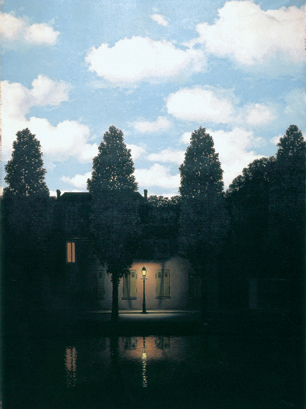
(Illustration: Rene Magritte, The Empire of Light)

Wednesday, February 15, 2012

Life Returns to the Uroboros/ Space Does Not Go Anywhere/ Section 14

By Brian George

If human meaning is the shadow of a shadow, how far back must we go to discover the source of illumination? A moon has obscured the superconscious sun.

Is knowledge of the world a matter of addition or subtraction? If the world is a subject, should the self then be regarded as on object? The self obeys the tutelary genius that has covered up its eyes. Existence is a phenomenon whose essence has already—and long since!—passed from view. Presence articulates its plan through absence, as a cargo cult sets fire to the few remaining books, and whole continents and their peoples are removed. Nature’s death suggests that there may be something wrong.

In fact, the error is a basic one—far older than the universe itself—and would seem to be implanted in our DNA. It is as follows: that the one is a number. The correct view is as follows: that the number one is not actually a number. It does not grow bigger when it is added to itself. So too, it can never become smaller. How strange that the simplest thing is also the most complex! Thus, as with the one, we cannot observe too directly the configuration of the self.

At the end of the world, there is never more than one consciousness left standing. There is no hook in the sky upon which to hang one’s hat. A Promethean technocracy floats on the pregnant waters of illusion. Signs camouflage the perfect guardians of the Zodiac. Though they know all, they are empty. Of the meaning of a life we can only say: “It was.”

(Illustration: Rene Magritte)

Tuesday, February 14, 2012

Life Returns to the Uroboros/ Space Does Not Go Anywhere/ Sections 12 and 13

By Brian George

12
The Gnostic teacher Valentinus wrote, “What liberates is the knowledge of what we were; of what ego and self are; of whereto we evolve; of wherefrom we are thrown; of what birth is, and how it differs from rebirth.” (Translation by the author.)

13
Gnostics believed that matter was the consequence of “hyle”—error, an ancient flaw in the structure of creation. Consciousness preexisted the soul's descent into space. Gods were not different from monsters. Time was a snake, or vice versa; its knowledge, although encyclopedic, fell upon deaf ears. The Earth was an abomination. Sophia was violated by an army of perverse hypnotic fields.

Hallucinations made species. 12 birds forgot that amnesia was in charge, and, without thanks, continued to hatch eggs. From each shell stepped an Aeon, still wet behind the ears. So drunk were we that, in the mirror, we could not recognize our own radioactive faces, and these perfect beings seemed, at first, more terrible than the gods. Dead seas haunted languages. Blood erected—as from a catalog of bones—the totalitarian tower.

The omnipotent played games—for no good reason, or just because they could. Prosthetic hands were transplanted. Ego was the each day more ignorant shadow of the self. The body was a corpse—a kind of afterbirth.  A dream of history turned philosophers to stone. Self-consciousness was the fly in the ointment of the Archons, or planetary lords—a metaphysical black hole that led to the circumference.


(Illustration: Alberto Savinio)